Neuronal PPP2R5C in plasma is a potential biomarker for early diagnosis of Alzheimer’s disease
Neuronal PPP2R5C in plasma is a potential biomarker for early diagnosis of Alzheimer’s disease
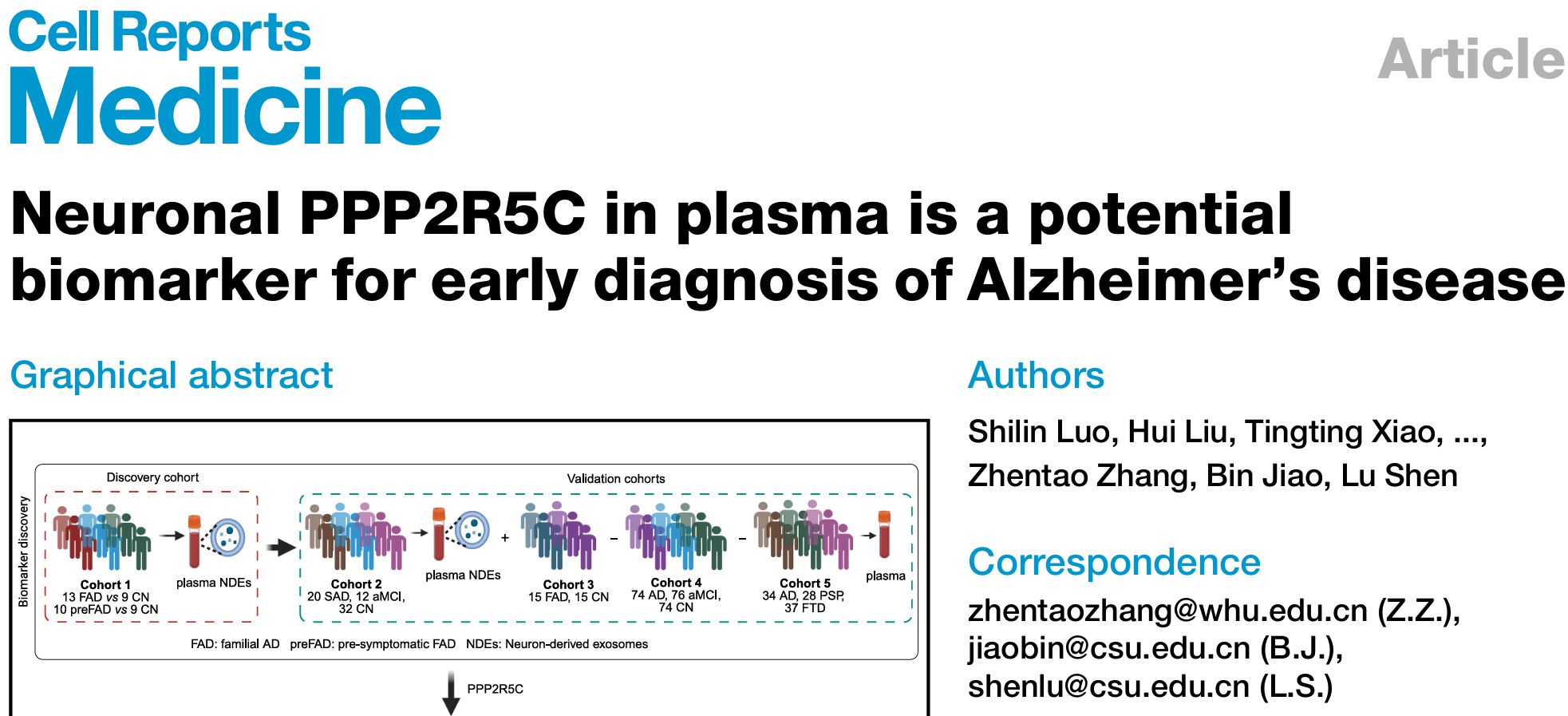
•PPP2R5C reduces Tau and p-Tau via ULK1-dependent autophagolysosomal and PP2A activation
Early intervention is the most effective strategy to impede the progression of Alzheimer’s disease (AD), depending on the identification of early diagnostic biomarkers. Here, we isolate neuron-derived exosomes (NDEs) from plasma of familial AD (FAD), presymptomatic FAD (pre-FAD), and healthy controls (cognitively normal [CN]), followed by label-free liquid chromatography-tandem mass spectrometry (LC-MS/MS) analysis. A specific peptide from protein phosphatase 2 regulatory subunit B'β (PPP2R5C) shows a progressive decrease from CN to pre-FAD and FAD patients. This decline is further validated in plasma NDEs and brain tissue from amnestic mild cognitive impairment (aMCI) and sporadic AD (SAD) patients. Two independent cohorts confirm the early and differential diagnostic value of plasma PPP2R5C. Immunohistochemistry of Tau Braak-staged brains reveals PPP2R5C reduction preceding Tau hyperphosphorylation. Mechanistically, PPP2R5C interacts with Tau, reducing Tau levels and phosphorylation via unc-51-like kinase 1 (ULK1)-dependent autophagolysosomal activation and PP2A regulation. Our findings suggest that plasma PPP2R5C has the potential to serve as an ideal biomarker for the early diagnosis of AD.
DOI: 10.1016/j.xcrm.2026.102631